
Bulgaria by campervan: best regions and routes
Where to go by campervan in Bulgaria: recommended regions, the best season, road access and practical route advice. What to know before you go.
Published 18 September 2026Last checked 19 September 2026
Currency
Euro
EUR. Adopted 1 January 2026 at the fixed rate of 1.95583 leva
Language
Bulgarian
Written in Cyrillic, which Bulgaria invented
Driving
Right
Motorway 140 km/h, 100 km/h from 3.5 to 7.5 tonnes
Power
230V, type F
The round two-pin Schuko socket
Road toll
E-vignette
€64.50 a year, €10 a week, prices from 1 August 2026
Emergency
112
Mountain rescue through 112. The old 1470 line closed in August 2026
Areas of Bulgaria
The regions of Bulgaria: coast, mountains and the old capitals
Bulgaria is small enough to cross in a long day and folded enough that it takes a week. The Black Sea coast is the busy edge and the one with its own law. Rila and Pirin in the southwest hold ten peaks over 2,700 metres. The Rhodopes in the south are forest, gorge and villages that feel further away than they are. The Balkan range cuts the country in half from west to east, with Veliko Tarnovo under it. Sofia sits in the far west with a mountain at the end of the street. Pick by the month and by how high you want to be.

The Black Sea coast
The Black Sea coast: the warmest water and the strictest rules
Three hundred and fifty kilometres of coast, and three different places along it. The north around Varna and Kavarna is cliff and pocket beach. The middle around Sunny Beach and Nessebar is the built resort strip. The south from Sozopol down to Sinemorets, where Strandzha nature park meets the sea, is the quiet end and the one worth the drive. Varna is the driest corner of the country, on about 526 millimetres of rain a year and 2,345 hours of sunshine.
Best late May to June and September
What it is like
- July and August are hot, full and expensive. Varna averages 29 °C and the resorts run at capacity.
- September is the month: the sea is at its warmest, the crowds have gone and the prices drop.
Where to go
- Nessebar, a UNESCO listed old town on a rock
- Sozopol and the coves south of it
For the vehicle
- The coast has its own act. Driving, parking and standing on the beach or on any dune is banned by the coastal act, at €511.29 to €1,533.88.
- Zone A runs 100 metres inland from the shore and zone B two kilometres beyond it, so the restrictions reach well back from the water.

Rila and Pirin
Rila and Pirin: the highest mountains in the Balkans
Two ranges in the southwest, both national parks, both above 2,900 metres. Rila holds Musala, the highest point in the Balkan peninsula at 2,925 metres, the Seven Lakes cirque and Rila Monastery in its own nature park. Pirin is sharper and more alpine, marble and granite, and is on the UNESCO World Heritage list in its own right. Bansko at 925 metres is the base for Pirin and averages 27 °C in July, several degrees cooler than the plains.
Best late June to September
What it is like
- high. Snow lies in the cirques into June and the weather turns fast above the treeline.
- Cooler than anywhere else reachable by van in summer, which is why Bulgarians come here in August.
Where to go
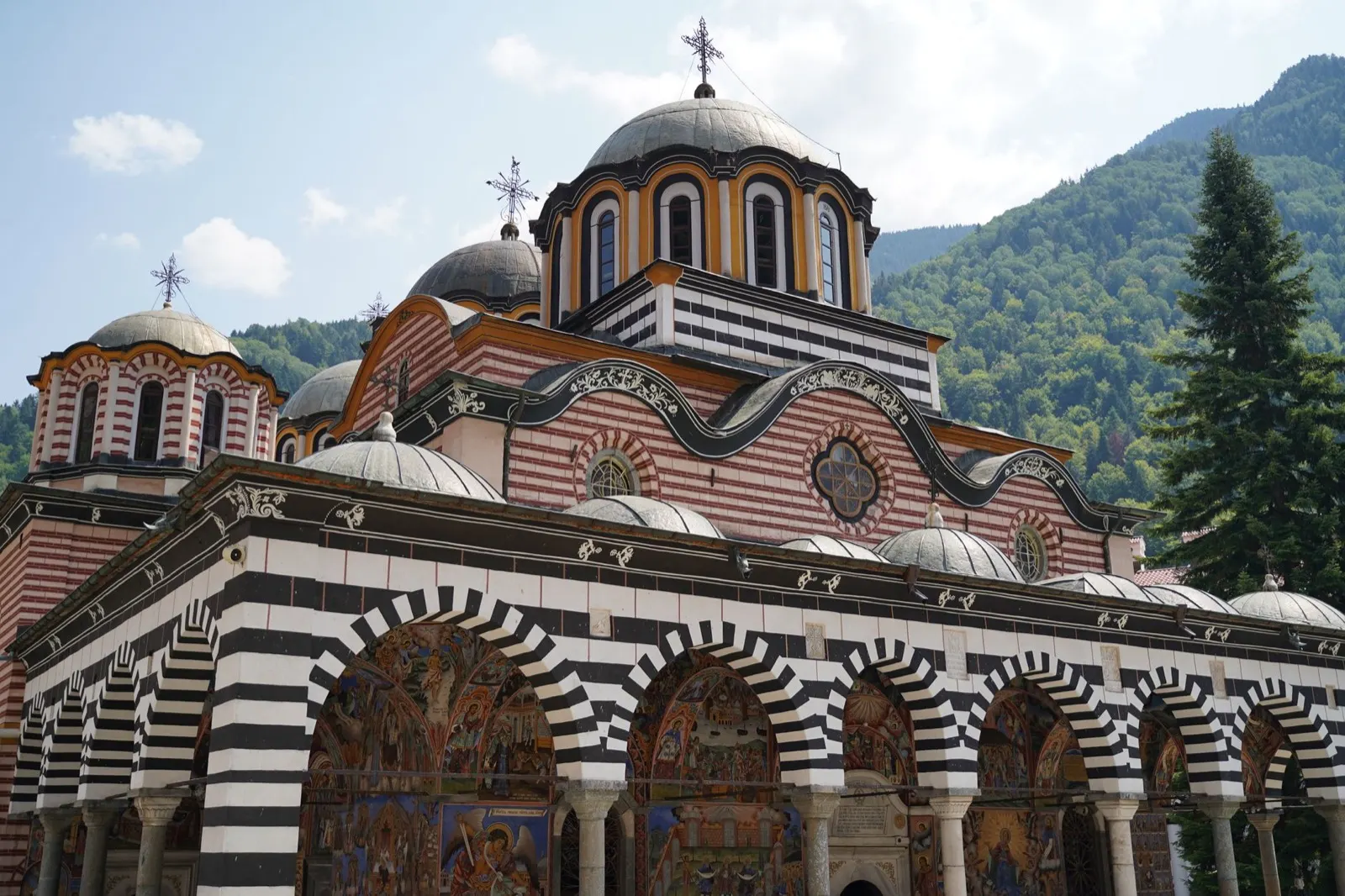
- Rila Monastery, a UNESCO site in its own nature park
- The Seven Rila Lakes, reached by chairlift and a walk
For the vehicle
- Both are national parks. Bivouacking and fires outside designated places are banned by the protected territories act at €255.65 to €2,556.46.
- Rila Monastery has its own nature park around it, where the same ban applies.

The Rhodopes
The Rhodopes: the quietest mountains in Bulgaria
A long, rounded, forested range along the Greek border, split into a higher, wetter western half around Smolyan and Devin and a lower, drier eastern half around Kardzhali. This is the part of Bulgaria where the villages are furthest apart, the roads are slowest and the roadside stalls are best. Kardzhali averages 31 °C in July and August on 1991 to 2020 normals, and the higher western Rhodopes run several degrees below that.
Best May to June and September to October
What it is like
- Forest, gorge and meadow rather than bare rock. Walking and driving country in equal measure.
- The lowest rainfall months are August and September, which makes early autumn the reliable window.
Where to go
- The Trigrad and Buynovo gorges
- Devil's Throat cave and the Yagodina cave
For the vehicle
- Much of the range is forest territory, so the forest act applies: drive forest roads only with permission or where they are marked for it.
- Fires are banned in forest territory, and within 100 metres of the forest boundary during the declared fire season.