
Romania by campervan: best regions and routes
Where to go by campervan in Romania: recommended regions, the best season, road access and practical route advice. What to know before you go.
Published 18 September 2026Last checked 19 September 2026
Currency
Romanian leu
RON, not the euro. 5.2644 lei to €1 on 18 September 2026
Language
Romanian
A Romance language in the Latin alphabet
Driving
Right
Motorway 130 km/h, 90 km/h from 3.5 to 7.5 tonnes
Power
230V, type F
The round two-pin Schuko socket
Road toll
Rovinietă
9.50 euro for 30 days in a car, September 2026
Emergency
112
Mountain rescue, Salvamont, on 0725 826 668
Areas of Romania
The regions of Romania: Transylvania, the Carpathians, the north and the Delta
Romania is built around the Carpathian arc, and almost every decision about a trip here is a decision about which side of it you are on. Transylvania sits inside the arc, Maramureș and Bucovina north of it, the Danube Delta far out east where the river ends. The mountains themselves are the reason most people come, and they are the part that closes for half the year.

Transylvania
Transylvania: fortified churches, three names per town and the easiest driving in Romania
The plateau inside the arc of the Carpathians, settled for centuries by Romanians, Hungarians and German Saxons, and it still shows in the architecture and on older maps. Sighișoara's historic centre and the villages with fortified churches are both on the UNESCO World Heritage list, and the country between Sibiu, Brașov and Cluj is hill villages, walled church yards and long views.
Best May to early October
What it is like
- Sibiu averages a daily maximum of 27 °C in July and August on 1991 to 2020 normals, and June is the wettest month at 97 mm.
- Saxon villages are laid out around a fortified church with a walled yard, built to be shut and defended.
Where to go
- Sighișoara, the walled hill town
- Sibiu and the Saxon villages around it
For the vehicle
- Towns carry Romanian, Hungarian and German names. Road signs use the Romanian one, so set the satnav to that rather than to what the guidebook says.
- Park outside the walled centres and walk in. Sighișoara's old town is a hill of cobbles.

The Carpathians
The Carpathians: the two high roads and the national parks of Romania
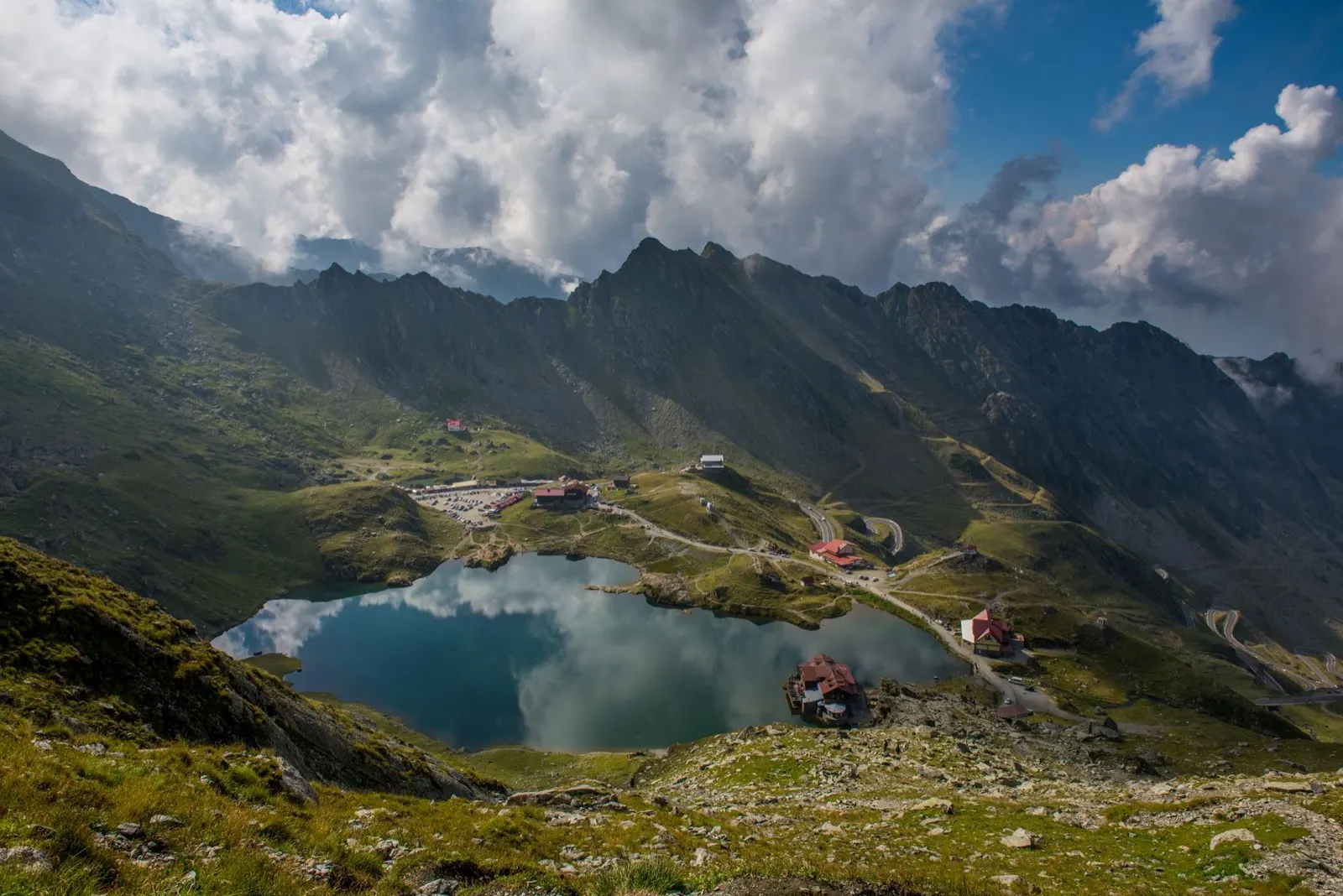
The mountain spine that curls through the middle of the country, holding the Făgăraș ridge, Piatra Craiului, Retezat and the Dacian fortresses of the Orăștie mountains. It carries the two roads people come to Romania to drive, the Transfăgărășan and the Transalpina, and it is the part of the country where the rules are strictest and the season is shortest.
Best late June to September
What it is like
- Brașov under the southern edge averages 27 °C in July on 2014 to 2026 normals, and the passes above it are far cooler.
- June is the wettest month and the greenest. September is the driest of the good months.
Where to go
- The Transfăgărășan, DN7C, and Bâlea Lac at the top
- The Transalpina, DN67C, from Rânca to Curpăt
For the vehicle
- Both high roads open late and close at night. In 2026 the Transfăgărășan opened on 12 June and runs 07:00 to 21:00, and the Transalpina reopened on 29 May with a 30 km/h limit and no vehicles over 3.5 tonnes.
- Driving off the road onto a protected area is a contravention at 5,000 to 10,000 lei for an individual under the protected areas law.

Maramureș
Maramureș: wooden churches and hay meadows in the far north of Romania
The far north west, against the Ukrainian border, where the Wooden Churches of Maramureș are on the UNESCO World Heritage list and the hay is still cut by hand in places. Tall shingled spires, carved gates, and a valley culture that has been photographed a great deal and changed less than that would suggest. Baia Mare is the city and the practical base.
Best May to September
What it is like
- Baia Mare averages 29 °C in July and August on 2014 to 2026 normals, warmer than most of the north.
- It rains all year here rather than in a summer peak. January gets 68 mm and July 84 mm.
Where to go
- The wooden churches at Bârsana, Ieud and Poienile Izei
- Săpânța and the carved painted cemetery
For the vehicle
- Valley roads are narrow and shared with carts and farm traffic. A long van needs patience rather than speed.
- Church yards are working parish ground. Park outside and ask before you stay anywhere near one.