
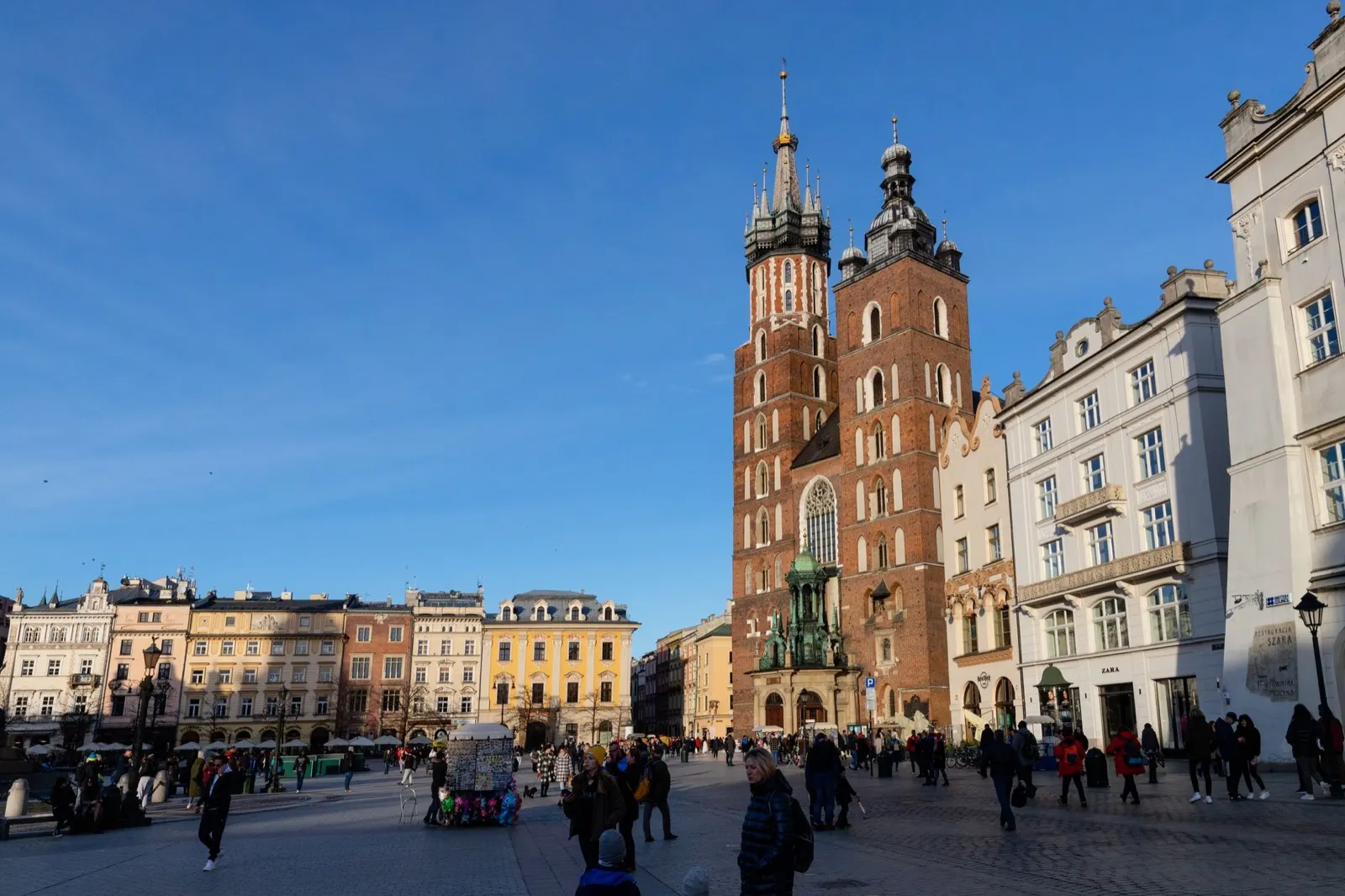
Poland by campervan
Polish statute does not regulate sleeping inside a legally parked vehicle. What it regulates is camping, and camping in a forest or a national park outside a designated place is an offence. The currency is the złoty, the motorways are free under 3.5 tonnes, and almost every shop is shut on almost every Sunday.
Published 18 September 2026Last checked 19 September 2026
Currency
Polish złoty
PLN, not the euro. 4.36 zł to €1 on 18 September 2026
Language
Polish
Latin alphabet with nine extra letters
Driving
Right
Motorway 140 km/h, but 80 km/h over 3.5 t
Power
230V, type E
A Schuko plug fits the socket
Alcohol
0.2 promille
An offence from 0.2, a crime above 0.5
Emergency
112
Mountain rescue 601 100 300
Basics
Basics
The single most useful thing to know about Poland is that Sunday is not a shopping day. Trading on Sunday is banned by statute, with a short list of exceptions, so a weekend arrival that plans to stock the van on Sunday morning finds a petrol station and a bakery and not much else. 2026 has eight trading Sundays, and they are listed in the food panel.

The Polish day
- Śniadanie is at home. Bread, cheese, cold cuts, tomato.
- Obiad, roughly 13:00 to 16:00. The main meal of the day, soup then a plate.
Power, water and getting online
- 230V, 50Hz, type E sockets. The socket has an earth pin sticking out of it. French plugs fit directly, German Schuko plugs fit too, UK and Irish plugs need an adapter.
- Mains water is treated to drinking standard. Many Polish households still filter it or buy bottled, so take the lead from where you are.
24 December is now a full public holiday. It was added to the list by an amendment that took effect on 1 February 2025, so Christmas Eve is no longer a normal working day with shops open until lunchtime.
Common questions about Poland by campervan
Can you sleep in a campervan in Poland?
Yes, where the vehicle is legally parked. Polish law does not regulate sleeping inside a parked vehicle, so a campervan standing in a place where any vehicle may park is simply parked. What the statutes regulate is camping. Putting out a tent, an awning, chairs or a table, lowering stabiliser legs, lighting a fire or emptying waste water on the ground turns parking into camping, and camping is restricted in forests and banned in national parks outside designated places.
Is wild camping legal in Poland?
No, not in a forest or a national park. The Ustawa o lasach bans camping in forests outside places designated by the forest owner or the forest district manager, and the Ustawa o ochronie przyrody bans it in national parks and nature reserves outside places designated by the park director. An on-the-spot fine is capped at 500 zł and a court can impose 20 to 5,000 zł. The State Forests do designate legal areas, under a programme called Zanocuj w lesie, but those are for tents and hammocks.
Does Zanocuj w lesie let me sleep in a campervan in the forest?
No. The programme designates about 643,000 hectares of State Forest where you may legally sleep, for up to nine people and up to two consecutive nights with nothing to book, but it does not cover vehicles. The programme's own FAQ answers the question directly: driving into the forest with vehicles is prohibited, and the areas are meant for people with hammocks or tents. The regulamin tells you to leave the car at a nearby forest car park and walk in.
Do I pay tolls in Poland in a campervan?
Only on the three privately run concession stretches, if your vehicle and anything behind it weigh 3.5 tonnes or less. The state e-TOLL system applies to vehicles and combinations over 3.5 tonnes and to buses, and from 21 September 2026 a light vehicle towing a trailer stops paying too. A two-axle vehicle pays 141 zł for the A2 from Świecko to Konin, 29.90 zł for the A1 from Rusocin to Nowa Wieś, and 18 zł at each of the two plazas on the A4 between Katowice and Kraków.